A good interior design proposal tells the client exactly what you'll do, what you won't do, how the project will run, what it costs and how to say yes. Copy the template below, replace the items in square brackets, and adapt it to your studio and project.
A proposal is a sales document and a project management tool. Written well, it wins the job and also prevents the most common later argument: "I thought that was included."
Free interior design proposal template
INTERIOR DESIGN PROPOSAL

Prepared for: [Client name]
Prepared by: [Studio name], [Contact details]
Project: [Project name and address]
Date: [Date]
Valid until: [Date]

1. YOUR PROJECT
Thank you for inviting us to work with you on [project]. From our conversation, we understand that you want to [main goal]. Your priorities are:
- [Priority 1]
- [Priority 2]
- [Priority 3]

2. SCOPE OF WORK
Areas included: [List rooms or areas]
Services included:
- [Service, such as space planning]
- [Service, such as concept and moodboards]
- [Service, such as drawings and schedules]
- [Service, such as material and furniture selection]
- [Service, such as procurement support]
- [Service, such as site visits: state how many]

Not included:
- [Exclusion, such as structural engineering]
- [Exclusion, such as permit fees]
- [Exclusion, such as areas not listed above]

3. HOW WE'LL WORK TOGETHER
Phase 1, Discovery: [Outputs]. You approve: the brief.
Phase 2, Concept: [Outputs]. You approve: the design direction.
Phase 3, Design development: [Outputs]. You approve: the design and budget.
Phase 4, Documentation: [Outputs]. You approve: final drawings and quotes.
Phase 5, Procurement: [Outputs]. You approve: orders.
Phase 6, Installation: [Outputs]. You approve: the punch list.
Phase 7, Handover: [Outputs]. You accept: the completed project.

4. ESTIMATED TIMELINE
Estimated start: [Date]
Estimated design completion: [Date]
Estimated project completion: [Date]
These dates depend on timely decisions and on supplier and contractor availability. We will request each decision by a stated date.

5. REVISIONS AND CHANGES
This proposal includes [number] rounds of revisions at each of these phases: [phases].
Further revisions, and any change after approval, will be quoted before work begins, including the effect on cost and time.

6. YOUR INVESTMENT
Design fee: [Amount and basis: fixed, hourly or percentage]
Project management fee: [Amount and basis, or "Included"]
Estimated budget for construction, furniture and materials: [Amount or range]
This budget is an estimate and is separate from our fee unless stated.

Payment schedule:
- [Percentage or amount] on acceptance
- [Percentage or amount] on [milestone]
- [Percentage or amount] on [milestone]
Additional costs: [Travel, samples, printing, and how they are charged]
Taxes: [State whether amounts include applicable tax]

7. HOW APPROVALS WORK
All approvals will be given in writing by [approving person's name]. Work proceeds to the next phase once the current phase is approved.

8. TERMS
This proposal is subject to our terms and conditions: [Attach or link]. They cover cancellation, ownership of designs, liability and dispute resolution.

9. NEXT STEPS
1. Sign below to accept this proposal.
2. Pay the initial fee of [amount].
3. We will schedule your discovery meeting within [number] days.

ACCEPTANCE
Client name: ____________________
Signature: ____________________ Date: __________

Studio representative: ____________________
Signature: ____________________ Date: __________
This template is a starting point, not legal advice. Laws differ by location, so have a qualified lawyer review your terms before you use them.
What to include in each section
Your project
Use the client's own words wherever you can. Showing that you listened is often more persuasive than a long list of your credentials. Keep it to one short section.
Scope of work
This is the section that protects you most. Be specific about areas and services, and always include a "not included" list. "Design of the living room" is open to interpretation. "Layout, one concept, finishes and furniture selection for the living room" is far clearer.
How you'll work together
Clients are often hiring a designer for the first time, so show them what the journey looks like, and what they'll be asked to approve at each step. Our guide to the interior design process explains each phase in more detail.
Timeline
Give estimates rather than promises, and state what they depend on. Be clear that client decisions affect the schedule. It's easier to raise this now than when the project is already late.
Revisions and changes
Unlimited revisions can quickly eat your profit. State how many rounds are included and how extra work is handled. A clear change process lets you say yes to a request without doing it for free.
Your investment
Separate your fee from the budget for construction, furniture and materials, because clients often confuse the two. Common fee structures include:
| Fee structure | How it works | Best when |
|---|---|---|
| Fixed fee | One agreed price for a defined scope | The scope is clear and unlikely to change |
| Hourly | Billed for time spent, often with an estimate | The scope is uncertain or the work is advisory |
| Percentage | A percentage of the project budget | Larger projects where effort scales with budget |
| Per area | A rate based on floor area | Your market commonly prices this way |
Approvals
Name one approving person where possible. This avoids mixed messages between family members or business partners, and tells your team whose yes counts.
Next steps
Make accepting easy. Tell the client exactly what to do, and what happens right after they do it.
How to write a proposal that wins the job
- Send it quickly. Send it while the conversation is still fresh, and say when you'll follow up.
- Walk through it together. A short review lets you answer questions before they turn into doubts.
- Lead with their goals. Open with what they want, then explain how you'll deliver it.
- Offer clear options. A design-only and a full-service option let the client choose how to work with you, rather than whether to.
- Show relevant work. Attach one or two similar projects rather than your whole portfolio.
Common proposal mistakes
- Leaving the scope vague, or leaving out exclusions.
- Quoting a single total that hides your fee inside the project budget.
- Forgetting an expiry date, which leaves old pricing open indefinitely.
- Not explaining what happens when something changes.
- Ending without a clear way to accept.
After the client says yes
The commitments in your proposal now need to be managed: phases, approvals, revisions and changes. Move them straight into your project system so they don't stay in a signed PDF. See our guide to interior design project management for how.
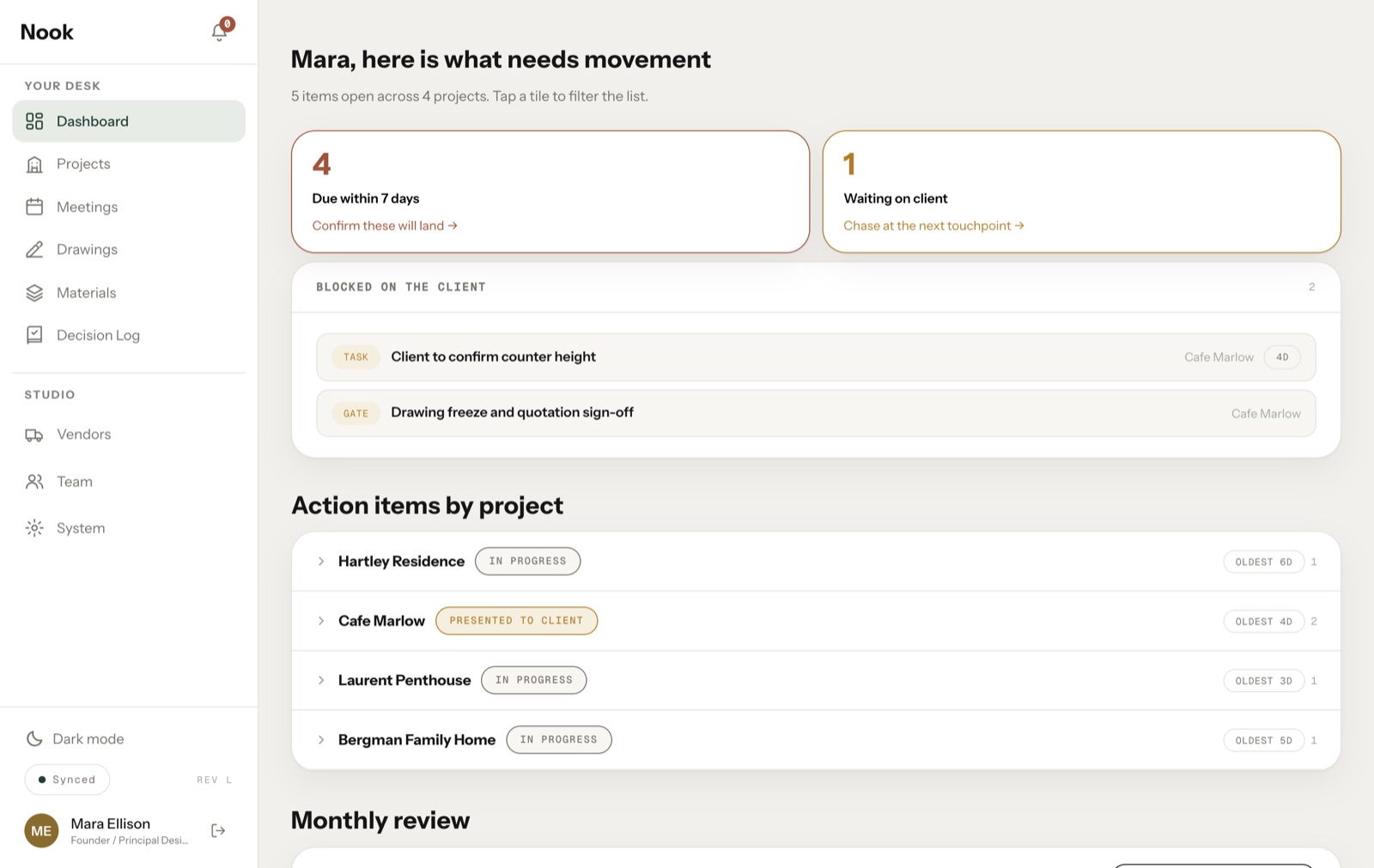
Nook, the software we're building for design studios, is designed for exactly this stage, with stages, checklists and recorded approvals in one place. It's currently in early access.
Frequently asked questions
What is the difference between a proposal and a contract?
A proposal sets out what you're offering and why. A contract is the legally binding agreement. Some studios combine them, so ask a lawyer what's appropriate where you work.
How long should an interior design proposal be?
Long enough to be clear, and no longer. For many projects, a few pages are enough. Your scope and exclusions deserve the most space.
Should you charge for a proposal?
Many studios write the proposal for free but charge for any design work or detailed site visit done before it. Whatever you decide, avoid giving away design ideas before the client has signed.